Cookies Policy
The website need some cookies and similar means to function. If you permit us, we will use those means to collect data on your visits for aggregated statistics to improve our service. Find out More
Accept Reject
  • Menu
Facts & Numbers
000
Presentation

Human-Centered Computing and Information Science

HumanISE is an interdisciplinary centre focused on research at the forefront of human-centred computing (HCC) with broad and deep expertise in computer science (CS) and information science (IS).

At HumanISE, engineers, scientists and designers focus on research and development of software systems, methods, and tools, capable of leveraging human abilities and practices within their communities and environments, involving high technical and managerial complexity, due to large scale, high heterogeneity, high uncertainty, high integrity, strict compliance to standards and legal frameworks, or domain-specific organisational issues.

Our mission is to pursue high-quality research, innovation, consultancy, and technology transfer, impactful, in close cooperation with academic and industrial partners. We focus on five main research areas - Computer-Human Interaction, Computer Graphics and Interactive Digital Media, Information Management and Information Systems, Software Engineering, and Large Scale and Special Purpose Computing Systems, Languages and Tools - and four innovation areas - Personalised Health Research, Earth, Ocean and Space Science, Geospatial Information Systems Engineering, and Information Systems and Applied Computing.

Furthermore, at HumanISE, we are also strongly committed to training young researchers and professionals, with a significant track record in the supervision of master and PhD students.

Presently, our researchers originate from the University of Porto (UP), Polytechnic of Porto (IPP), University of Trás-os-Montes e Alto Douro (UTAD), Universidade Aberta (UAb) and University of Minho (UM).

Latest News
Computer Science and Engineering

Portugal’s semiconductor dialogue takes shape with contributions from INESC TEC – six months after the kick off of the Competence Centre

Portugal’s position within the semiconductor ecosystem was one of the topics discussed at an event promoted by the Portuguese Competence Centre for Semiconductors (POEMS) – which features INESC TEC as a partner.

21st November 2025

Computer Science and Engineering

INESC TEC and Águas do Douro e Paiva sign collaboration protocol

On 31 October, INESC TEC signed a new collaboration protocol with Águas do Douro e Paiva (AdDP) at AdDP’s facilities in Lever.

06th November 2025

Computer Science and Engineering

Seniors training with Artificial Intelligence? The future (really is) today

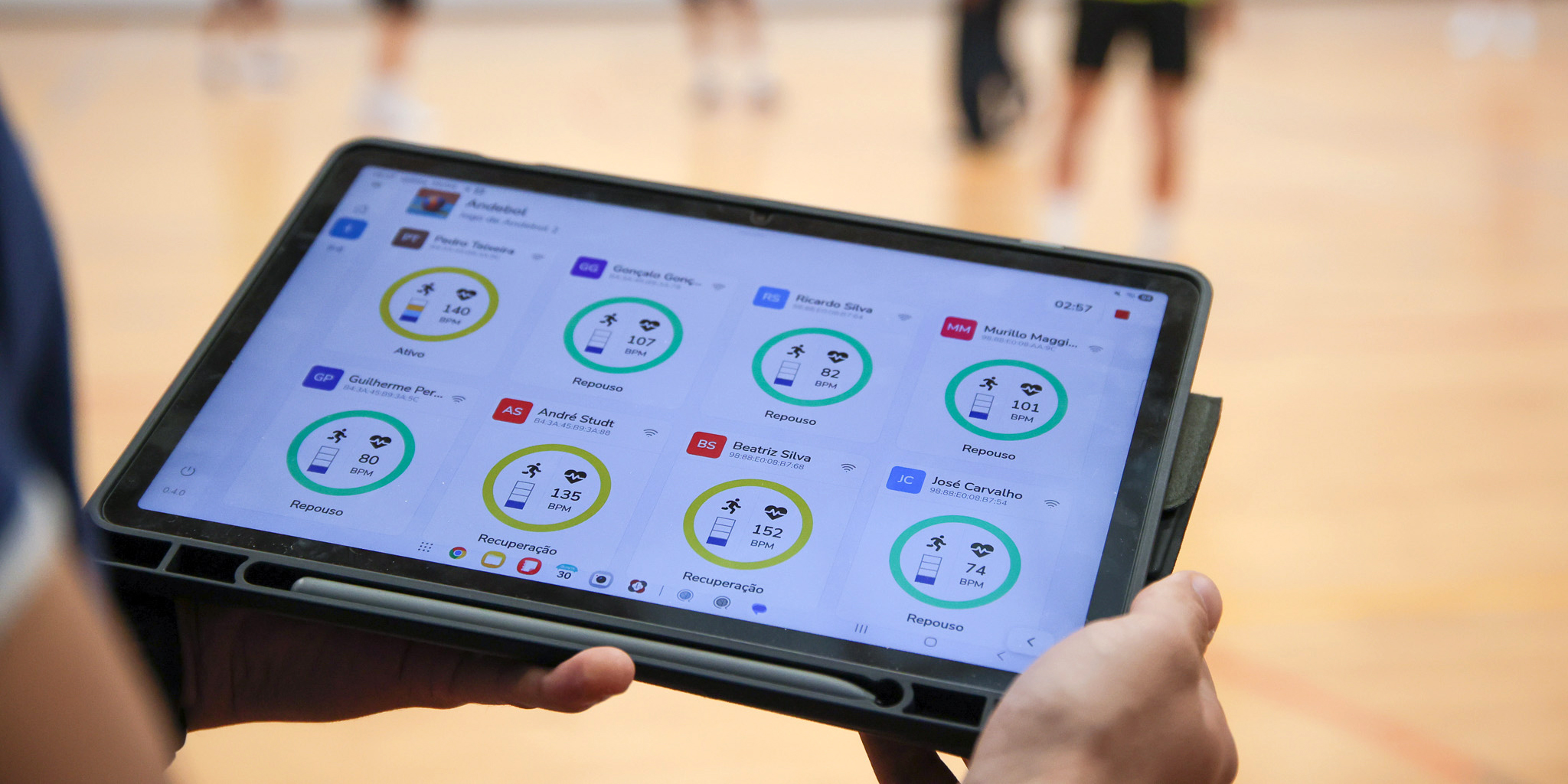
The project is called IATOS and it aims to make remote physical training safer, more effective, and accessible for older adults. Led by a consortium including INESC TEC, AGIT TECH, and the University of Trás-os-Montes and Alto Douro, the initiative seeks to create a digital platform for AI-assisted physical training, specifically designed for people over 65.

29th September 2025

Power and Energy Systems

There are innovative technological solutions to be developed for local energy markets – with contributions from INESC TEC

The delay in generating synthetic data for time series – fundamental elements in energy forecasting scenarios – was one of the motivations for GENESIS, a project that aims to provide local electricity markets with contextual synthetic data and reliable artificial intelligence models.

22nd September 2025

Computer Science and Engineering

INESC TEC researchers organised an international conference on computer vision and computer graphics

The VISIGRAPP 2025 - 20th International Joint Conference on Computer Vision, Imaging and Computer Graphics Theory and Applications - took place in Porto, in late February. It brought together more than 380 researchers and professionals interested in keeping up with and discussing theoretical advances and applications in Computer Vision, Computer Graphics, Human-Computer Interaction, and Information Visualisation - the main themes of the co-located conferences VISAPP, GRAPP, HUCAPP, and IVAPP, respectively. One of the co-chairs of this conference was INESC TEC researcher A. Augusto de Sousa.

27th March 2025

001

Featured Projects

ImagineVR

semI-autoMatic immersive trAininG orchestration in virtual rEality

2026-2027

Team
003

Laboratories

Information Systems Laboratory

Laboratory of Software Engineering

Laboratory of Computer Graphics and Virtual Environments

Publications

HumanISE Publications

View all Publications

2026

Adaptive Wine Recommendation in Online Environments

Authors
de Azambuja R.X.; Morais A.J.; Filipe V.;

Publication
Lecture Notes in Networks and Systems

Abstract
Deep learning and large language models (LLMs) have recently enabled studies in state-of-the-art technologies that enhance recommender systems. This research focuses on solving the next-item recommendation problem using these challenging technologies in Web applications, specifically focusing on a case study in the wine domain. This paper presents the characterization of the framework developed for the object of study: adaptive recommendation based on new modeling of the initial data to explore the user’s dynamic taste profile. Following the design science research methodology, the following contributions are presented: (i) a novel dataset of wines called X-Wines; (ii) an updated recommender model called X-Model4Rec—eXtensible Model for Recommendation supported in attention and transformer mechanisms which constitute the core of the LLMs; and (iii) a collaborative Web platform to support adaptive wine recommendation to users in an online environment. The results indicate that the solutions proposed in this research can improve recommendations in online environments and promote further scientific work on specific topics.

2026

Cross-Lingual Information Retrieval in Tetun for Ad-Hoc Search

Authors
Araújo, A; de Jesus, G; Nunes, S;

Publication
Lecture Notes in Computer Science

Abstract
Developing information retrieval (IR) systems that enable access across multiple languages is crucial in multilingual contexts. In Timor-Leste, where Tetun, Portuguese, English, and Indonesian are official and working languages, no cross-lingual information retrieval (CLIR) solutions currently exist to support information access across these languages. This study addresses that gap by investigating CLIR approaches tailored to the linguistic landscape of Timor-Leste. Leveraging an existing monolingual Tetun document collection and ad-hoc text retrieval baselines, we explore the feasibility of CLIR for Tetun. Queries were manually translated into Portuguese, English, and Indonesian to create a multilingual query set. These were then automatically translated back into Tetun using Google Translate and several large language models, and used to retrieve documents in Tetun. Results show that Google Translate is the most reliable tool for Tetun CLIR overall, and the Hiemstra LM consistently outperforms BM25 and DFR BM25 in cross-lingual retrieval performance. However, overall effectiveness remains up to 26.95% points lower than that of the monolingual baseline, underscoring the limitations of current translation tools and the challenges of developing an effective CLIR for Tetun. Despite these challenges, this work establishes the first CLIR baseline for Tetun ad-hoc text retrieval, providing a foundation for future research in this under-resourced setting. © The Author(s), under exclusive license to Springer Nature Switzerland AG 2026.

2026

User Behavior in Sports Search: Entity-Centric Query and Click Log Analysis

Authors
Damas, J; Nunes, S;

Publication
Lecture Notes in Computer Science

Abstract
Understanding user behavior in search systems is essential for improving retrieval effectiveness and user satisfaction. While prior research has extensively examined general-purpose web search engines, domain-specific contexts—such as sports information—remain comparatively underexplored. In this study, we analyze over 400,000 interaction log entries from a sports-oriented search engine collected over a two-week period. Our analysis combines classic query-level metrics (e.g., frequency distributions, query lengths) with a detailed examination of click behavior, including entropy-based intent variability and a custom query quality scoring model. Compared to established baselines from general and specialized search environments, we observe a high proportion of new and single-term queries, as well as a notable lack of representativeness among top queries. These findings reveal patterns shaped by the event-driven and entity-centric nature of sports content, offering actionable insights for the design of domain-specific retrieval systems. © The Author(s), under exclusive license to Springer Nature Switzerland AG 2026.

2026

Immersion for AI: Immersive Learning with Artificial Intelligence

Authors
Morgado, L;

Publication
IMMERSIVE LEARNING RESEARCH NETWORK, ILRN 2025

Abstract
This work reflects upon what Immersion can mean from the perspective of an Artificial Intelligence (AI). Applying the lens of immersive learning theory, it seeks to understand whether this new perspective supports ways for AI participation in cognitive ecologies. By treating AI as a participant rather than a tool, it explores what other participants (humans and other AIs) need to consider in environments where AI can meaningfully engage and contribute to the cognitive ecology, and what the implications are for designing such learning environments. Drawing from the three conceptual dimensions of immersion-System, Narrative, and Agency-this work reinterprets AIs in immersive learning contexts. It outlines practical implications for designing learning environments where AIs are surrounded by external digital services, can interpret a narrative of origins, changes, and structural developments in data, and dynamically respond, making operational and tactical decisions that shape human-AI collaboration. Finally, this work suggests how these insights might influence the future of AI training, proposing that immersive learning theory can inform the development of AIs capable of evolving beyond static models. This paper paves the way for understanding AI as an immersive learner and participant in evolving human-AI cognitive ecosystems.

2026

An Explosion of the Uses of Immersive Learning Environments: A Mapping of Reviews Update

Authors
Beck, D; Morgado, L; O'Shea, P;

Publication
IMMERSIVE LEARNING RESEARCH NETWORK, ILRN 2025

Abstract
Since the publication of the 2020 paper, Finding the Gaps About Uses of Immersive Learning Environments: A Survey of Surveys, the landscape of immersive learning environments (ILEs) has continued to evolve rapidly. This update aims to revisit the gaps identified in that previous research and explore emerging trends. We conducted an extensive review of new surveys published after that paper's cut date. Our findings reveal a significant amount of new published reviews (n = 64), more than doubling the original corpus (n = 47). The results highlighted novel themes of usage of immersive environments, helping bridge some 2020 research gaps. This paper discusses those developments and presents a consolidated perspective on the uses of immersive learning environments.