Cookies
O website necessita de alguns cookies e outros recursos semelhantes para funcionar. Caso o permita, o INESC TEC irá utilizar cookies para recolher dados sobre as suas visitas, contribuindo, assim, para estatísticas agregadas que permitem melhorar o nosso serviço. Ver mais
Aceitar Rejeitar
  • Menu
Factos & Números
000
Apresentação

Centro de Telecomunicações e Multimédia

A nossa visão é promover um mundo animado e sustentável onde a inteligência em rede permite uma interação ubíqua com o conteúdo sensorial. A missão é desenvolver sistemas e tecnologias avançadas para permitir comunicações de alta capacidade, eficientes e seguras, extração de conhecimento dos média e aplicações multimédia ubíquas imersivas.

No CTM trabalhamos em quatro áreas principais de investigação: Tecnologias Óticas e Eletrónicas, Redes Sem Fios, Tecnologias Multimédia e de Comunicações, e Processamento de Informação e Reconhecimento de Padrões.

Últimas Notícias
Comunicações

INESC TEC antecipa o futuro da conetividade com validação de demonstrador de superfícies inteligentes

O INESC TEC desenvolveu um demonstrador que mostra como poderá ser a próxima geração de conectividade: paredes, janelas ou móveis capazes de ajudar dispositivos a comunicar melhor. Esta tecnologia faz parte do projeto europeu SUPERIOT e já foi testada com sucesso, abrindo, assim, novas possibilidades para edifícios inteligentes, automação industrial, logística e comunicações indoor de elevada fiabilidade.

15 dezembro 2025

Comunicações

Novos métodos de pesquisa multimédia do INESC TEC em destaque em conferências internacionais

O investigador do INESC TEC, Luís Vilaça, foi reconhecido pela comunidade científica internacional pela apresentação de dois artigos em duas das conferências mais prestigiadas na área da multimédia, que ocorreram em Dublin: a IEEE International Conference on Content-Based Multimedia Indexing (CBMI) e a ACM Multimedia, esta última considerada A*, o mais elevado nível de excelência científica na área. Os artigos exploram novos métodos de pesquisa e recomendação de conteúdos audiovisuais que utilizam o próprio vídeo para criar descrições semânticas mais ricas.

24 novembro 2025

Comunicações

O INESC TEC foi a casa da Escola de Verão que juntou a teoria à prática para aumentar o conhecimento sobre as redes 6G

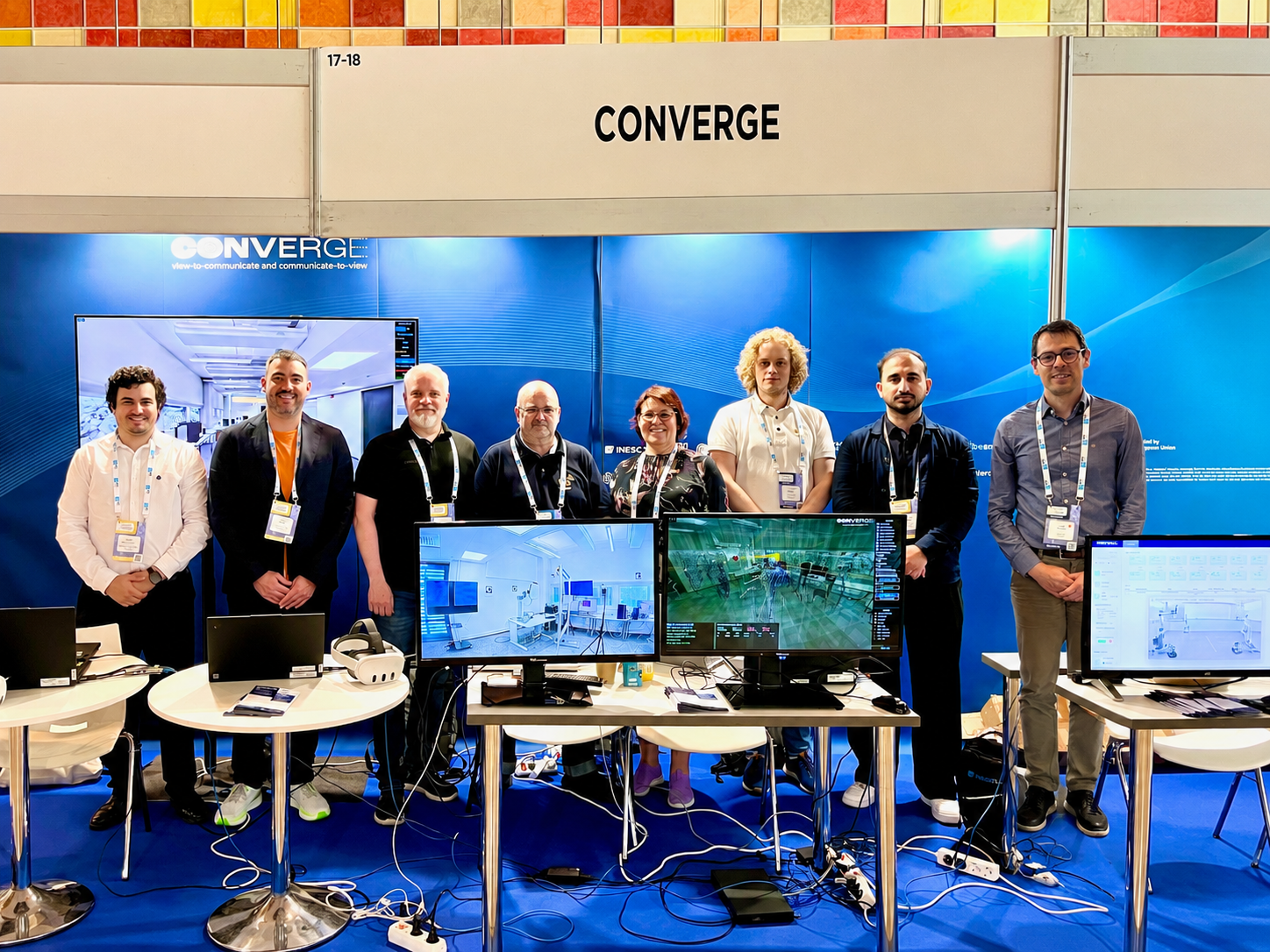
Três dias, 70 participantes, uma equipa de seis formadores e mais de 10 oradores de renome internacional – assim se fez a Summer School, organizada conjuntamente pelos projetos CONVERGE, liderado pelo INESC TEC, e SLICES-PP. O INESC TEC foi a casa desta Escola de Verão que proporcionou aos participantes uma experiência hands-on no desenvolvimento e experimentação de redes da próxima geração 6G.

19 agosto 2025

Comunicações

É possível tornar visível o invisível através de uma demonstração? Com o INESC TEC sim, através de realidade mista

O INESC TEC esteve em destaque num dos maiores encontros de especialistas que trabalham na área do 5G, IoT e 6G. Na EuCNC & 6G Summit 2025, que este ano se realizou em Poznan, na Polónia, o Instituto tornou visível o invisível através de uma demonstração com realidade mista.

26 junho 2025

Será que o vinho do Douro que temos à mesa é mesmo do Douro? O INESC TEC tem tecnologia para termos a certeza

O vinho de Portugal, o mel de Espanha, o azeite da Grécia, a carne da Alemanha, os lacticínios e pescado nórdicos: o que têm em comum? Estão todos ligados pelo WATSON, o projeto que traz para cima desta mesa tecnologias blockchain, inteligência artificial, visão computacional, sensores e sistemas de geolocalização para aumentar a rastreabilidade de produtos alimentares e contribuir para aumentar a informação, prevenção e combate à fraude.

29 maio 2025

Equipa
002

Laboratórios

Laboratório de Computação Musical e Sonora

Laboratório de Tecnologias Óticas e Eletrónicas

Publicações

2026

The 15-Minute City in Porto, Portugal: Accessibility for the elderly

Autores
Guerreiro, MS; Dinis, MAP; Sucena, S; Silva, I; Pereira, M; Ferreira, D; Moreira, RS;

Publicação
CITIES

Abstract
The concept of the 15-Minute City aims to enhance urban accessibility by ensuring that essential services are within a short walking distance. This study evaluates the accessibility of Porto, Portugal, particularly for the elderly, by assessing urban density, permeability, and walkability, with a specific focus on crossings and ramps. A five-step methodology was employed, including spatial analysis using QGIS and Place Syntax Tool, proximity assessments, and an in-situ survey of crossings and ramps in the CHP. The results indicate that while the city of Porto offers a dense and walkable urban environment, significant accessibility challenges remain due to inadequate ramp distribution. The data collection identified 80 crossings, of which only 60 were listed in OpenStreetMap, highlighting data inconsistencies. Additionally, 18 crossings lacked curb ramps, posing mobility barriers for elderly residents. These findings highlight the need of infrastructure improvements to support inclusive urban mobility. The study also proposes an automated method to enhance ramp data collection for broader applications. Addressing these gaps is crucial for achieving the equity and sustainability goals of the 15-Minute City model, ensuring that aging populations can navigate urban spaces safely and efficiently.

2026

Deciphering the Silent Signals: Unveiling Frequency Importance for Wi-Fi-Based Human Pose Estimation with Explainability

Autores
Capozzi, L; Ferreira, L; Gonçalves, T; Rebelo, A; Cardoso, JS; Sequeira, AF;

Publicação
PATTERN RECOGNITION AND IMAGE ANALYSIS, IBPRIA 2025, PT II

Abstract
The rapid advancement of wireless technologies, particularly Wi-Fi, has spurred significant research into indoor human activity detection across various domains (e.g., healthcare, security, and industry). This work explores the non-invasive and cost-effective Wi-Fi paradigm and the application of deep learning for human activity recognition using Wi-Fi signals. Focusing on the challenges in machine interpretability, motivated by the increase in data availability and computational power, this paper uses explainable artificial intelligence to understand the inner workings of transformer-based deep neural networks designed to estimate human pose (i.e., human skeleton key points) from Wi-Fi channel state information. Using different strategies to assess the most relevant sub-carriers (i.e., rollout attention and masking attention) for the model predictions, we evaluate the performance of the model when it uses a given number of sub-carriers as input, selected randomly or by ascending (high-attention) or descending (low-attention) order. We concluded that the models trained with fewer (but relevant) sub-carriers are competitive with the baseline (trained with all sub-carriers) but better in terms of computational efficiency (i.e., processing more data per second).

2026

Enhancing Medical Image Analysis: A Pipeline Combining Synthetic Image Generation and Super-Resolution

Autores
Sousa, P; Campai, D; Andrade, J; Pereira, P; Goncalves, T; Teixeira, LF; Pereira, T; Oliveira, HP;

Publicação
PATTERN RECOGNITION AND IMAGE ANALYSIS, IBPRIA 2025, PT II

Abstract
Cancer is a leading cause of mortality worldwide, with breast and lung cancer being the most prevalent globally. Early and accurate diagnosis is crucial for successful treatment, and medical imaging techniques play a pivotal role in achieving this. This paper proposes a novel pipeline that leverages generative artificial intelligence to enhance medical images by combining synthetic image generation and super-resolution techniques. The framework is validated in two medical use cases (breast and lung cancers), demonstrating its potential to improve the quality and quantity of medical imaging data, ultimately contributing to more precise and effective cancer diagnosis and treatment. Overall, although some limitations do exist, this paper achieved satisfactory results for an image size which is conductive to specialist analysis, and further expands upon this field's capabilities.

2026

Abnormal Human Behaviour Detection Using Normalising Flows and Attention Mechanisms

Autores
Nogueira, AFR; Oliveira, HP; Teixeira, LF;

Publicação
PATTERN RECOGNITION AND IMAGE ANALYSIS, IBPRIA 2025, PT I

Abstract
The aim of this work is to explore normalising flows to detect anomalous behaviours which is an essential task mainly for surveillance systems-related applications. To accomplish that, a series of ablation studies were performed by varying the parameters of the Spatio-Temporal Graph Normalising Flows (STG-NF) model [3] and combining it with attention mechanisms. Out of all these experiments, it was only possible to improve the state-of-the-art result for the UBnormal dataset by 3.4 percentual points (pp), for the Avenue by 4.7 pp and for the Avenue-HR by 3.2 pp. However, further research remains urgent to find a model that can give the best performance across different scenarios. The inaccuracies of the pose tracking and estimation algorithm seems to be the main factor limiting the models' performance. The code is available at https://github.com/AnaFilipaNogueira/Abnormal-Human-Behaviour-Detection- using-Normalising-Flows-and- Attention-Mechanisms.

2026

Unsupervised contrastive analysis for anomaly detection in brain MRIs via conditional diffusion models

Autores
Patrício, C; Barbano, CA; Fiandrotti, A; Renzulli, R; Grangetto, M; Teixeira, LF; Neves, JC;

Publicação
PATTERN RECOGNITION LETTERS

Abstract
Contrastive Analysis (CA) detects anomalies by contrasting patterns unique to a target group (e.g., unhealthy subjects) from those in a background group (e.g., healthy subjects). In the context of brain MRIs, existing CA approaches rely on supervised contrastive learning or variational autoencoders (VAEs) using both healthy and unhealthy data, but such reliance on target samples is challenging in clinical settings. Unsupervised Anomaly Detection (UAD) learns a reference representation of healthy anatomy, eliminating the need for target samples. Deviations from this reference distribution can indicate potential anomalies. In this context, diffusion models have been increasingly adopted in UAD due to their superior performance in image generation compared to VAEs. Nonetheless, precisely reconstructing the anatomy of the brain remains a challenge. In this work, we bridge CA and UAD by reformulating contrastive analysis principles for the unsupervised setting. We propose an unsupervised framework to improve the reconstruction quality by training a self-supervised contrastive encoder on healthy images to extract meaningful anatomical features. These features are used to condition a diffusion model to reconstruct the healthy appearance of a given image, enabling interpretable anomaly localization via pixel-wise comparison. We validate our approach through a proof-of-concept on a facial image dataset and further demonstrate its effectiveness on four brain MRI datasets, outperforming baseline methods in anomaly localization on the NOVA benchmark.

Factos & Números

19Artigos em revistas indexadas

2020

11Artigos em conferências indexadas

2020

2Contratados de I&D

2020

Contactos