

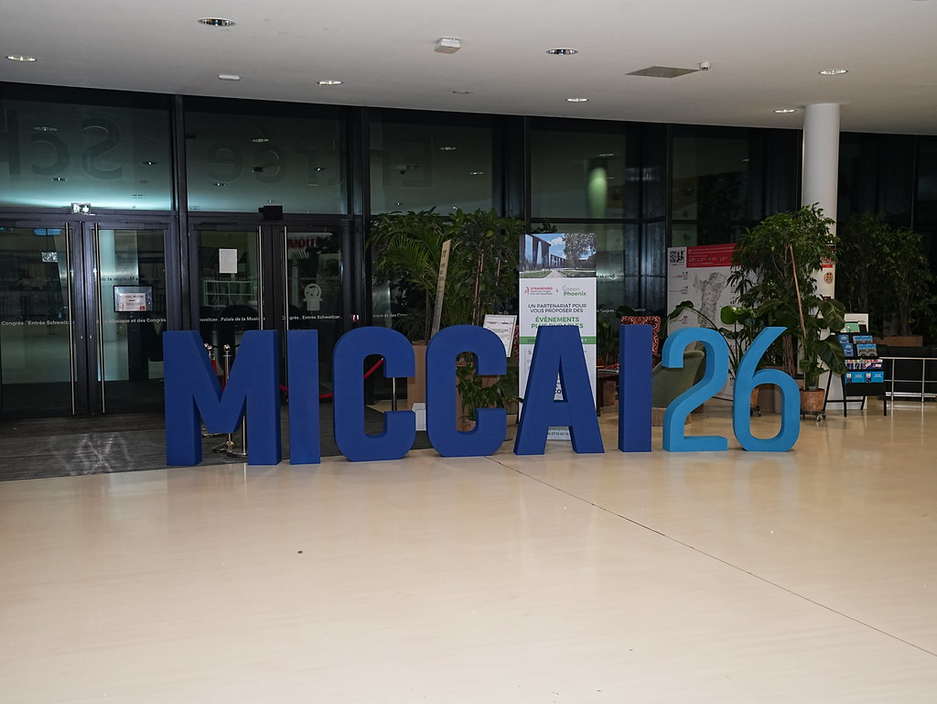
INESC TEC researchers presented their work at MICCAI 2026, a leading international conference on medical imaging
One keynote speech, a general co-chair role, four workshops, one tutorial, one award and one honourable mention: this was INESC TEC’s contribution to the 2026 MICCAI (International Conference on Medical Image Computing and Computer-Assisted Intervention) - one of the world’s leading conferences in medical imaging. Carla Monteiro, Henrique Romão, Jaime Cardoso, João Pedrosa and Tânia Melo travelled to Strasbourg to represent INESC TEC at the conference’s 29th edition, which brought together 3,000 participants.
22nd October 2026
The INESC TEC team, comprising researchers from Biomedical Engineering and Telecommunications and Multimedia, took part in satellite events - workshops and tutorials - rather than the main conference track.
“Workshops operate much like regular conferences, with submissions, peer review, presentations and indexed publications,” explained INESC TEC researcher João Pedrosa, who attended the event.
Jaime Cardoso served as general co-chair of the iMIMIC workshop (Workshop on Interpretability of Machine Intelligence in Medical Image Computing); dedicated to the interpretability and explainability of AI models in medical imaging, this was the 9th edition of workshop over the current year. According to the organisers, it is the only forum at MICCAI devoted exclusively to this topic.
Jaime Cardoso was also an invited keynote speaker at another workshop, RHEUM-AI: Trustworthy AI by Design - Structure, Interpretability, and Calibrated Uncertainty for Medical Imaging. This was the first workshop dedicated to advanced computational methods for rheumatological imaging. Alongside Jaime Cardoso, INESC TEC researcher and lecturer at FEUP, the event featured two other keynote speakers: Constantino Grana, from the University of Modena and Reggio Emilia, Italy, and Asier García Alija, from Hospital de la Santa Creu i Sant Pau / Hospital Universitari Dexeus, Spain.
“RHEUM-AI focused on applying Artificial Intelligence to medical imaging in rheumatology. Rheumatic and musculoskeletal diseases are chronic and affect many people. Their diagnosis and monitoring rely on examinations such as ultrasound, magnetic resonance imaging and X-rays, which can be difficult and time-consuming to interpret. Despite AI’s success in other fields, such as oncology and cardiology, rheumatology has received relatively little attention. The workshop aimed to change that and bring AI research closer to real clinical needs,” explained Jaime Cardoso.
At the TIA workshop (Thoracic Image Analysis), which brought together researchers, clinicians and industry professionals, Carla Monteiro and Tânia Melo presented two studies developed as part of the AI4Lungs project. Both focused on analysing high-resolution computed tomography (CT) scans in interstitial lung diseases, addressing the segmentation of imaging findings and the classification of the usual interstitial pneumonia (UIP) pattern. This pattern of changes in lung tissue is visible on CT scans and consists of characteristic features that help doctors identify a specific form of pulmonary fibrosis.
At the DeCaF workshop (Distributed Collaborative and Federated Learning), Henrique Romão presented another study within the scope of AI4Lungs. This work focused on the automated assessment of chest X-ray image quality to determine whether images are suitable for analysis, helping researchers train more reliable AI algorithms. The presentation was particularly relevant in a workshop devoted to federated learning, in which data remain within hospitals rather than being shared centrally. The study was developed in collaboration with CERN and involved former INESC TEC researcher Matilde Costa, as well as Diogo Reis Santos and Luigi Serio. Henrique Romão received the workshop’s Runner-Up award for best work.
The ORDER-AI tutorial focused on ordinal learning, which is relevant in healthcare for applications such as monitoring disease progression and patient stratification. INESC TEC researchers Jaime Cardoso and Ricardo Cruz were involved in organising the tutorial - led by former Institute researcher Wilson Silva, together with Jaime Cardoso, and with Carla Monteiro’s presence. Jaime Cardoso delivered the tutorial’s opening session, Ordinal Segmentation - From Independent Pixel Decisions to Spatially Consistent Ordered Structures, while Carla Monteiro led the session on ordinal classification.
INESC TEC also brought home an honourable mention. Researcher João Pedrosa received an Outstanding Reviewer Award honourable mention from MICCAI. Every year, the conference recognises the top reviewers. and although João Pedrosa has served as a reviewer on previous occasions, this year he was included among the honourable mentions. A total of 3,900 reviewers took part in the 2026 edition.
MICCAI 2026 set a record for paper submissions, accepting 1,167 papers out of 4,402 submissions, representing an acceptance rate of 27%, in line with previous years. The conference took place from 27 September to 1 October at the Strasbourg Convention Centre in France.