Cookies
O website necessita de alguns cookies e outros recursos semelhantes para funcionar. Caso o permita, o INESC TEC irá utilizar cookies para recolher dados sobre as suas visitas, contribuindo, assim, para estatísticas agregadas que permitem melhorar o nosso serviço. Ver mais
Aceitar Rejeitar
  • Menu
Apresentação

Fotónica Aplicada

Da ciência fundamental à inovação com impacto no mundo real: no nosso Centro de Fotónica Aplicada (CAP) exploramos os fenómenos óticos, uma caixa de ferramentas única para inovar no campo das micro e nanofabricação, sensores óticos, físicos e bioquímicos, e plataformas de simulação analógica e computação quânticas.


Os nossos investigadores estão de olhos postos no desenvolvimento de sistemas capazes de dar resposta em contextos onde a sensorização precisa e fiável é essencial (indústria, ambiente ou biomedicina) e em dispositivos óticos não lineares para construir simulações análogas quânticas e plataformas de computação. Os nossos avanços na sensorização fotónica permitem a sua utilização em cenários extremos, como o espaço ou as profundezas do mar.


A partir de uma organização não hermética, as soluções que desenvolvemos a partir do estudo da luz e fotões implicam multidisciplinaridade e trabalho cooperativo e de proximidade com os nossos diferentes domínios de investigação.


Com as nossas competências em fotónica e integração de sistemas eletrónicos, exploramos a possibilidade de transferência de tecnologia para a emergente indústria da fotónica nacional e internacional.
notícias
Fotónica

Como se prepara a transição das redes de gás? A resposta está nos sensores óticos desenvolvidos pelo INESC TEC

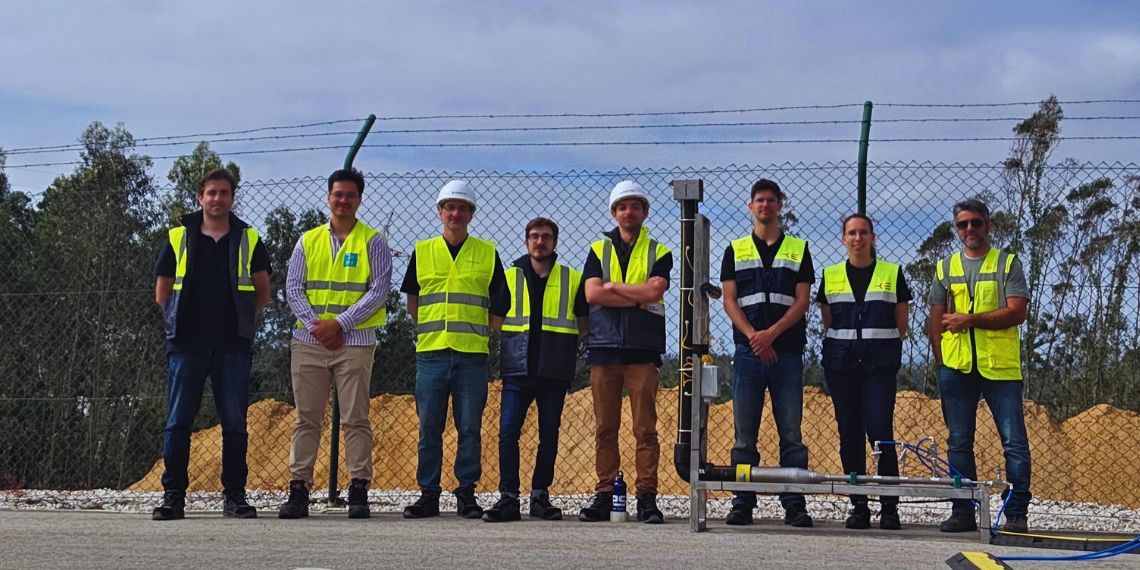
Uma fuga de hidrogénio ou de metano pode ser invisível, mas não passará despercebida a uma nova geração de sensores desenvolvidos pelo INESC TEC. Durante dois dias, investigadores do instituto instalaram e testaram nas instalações da PRF, em Leiria, uma tecnologia de monitorização de gases desenvolvida no âmbito do PRR Aliança para a Transição Energética (ATE).  

20 julho 2026

Fotónica

Quatro prémios e três nomeações para organizações setoriais – Fotónica do INESC TEC reconhecida em conferência internacional

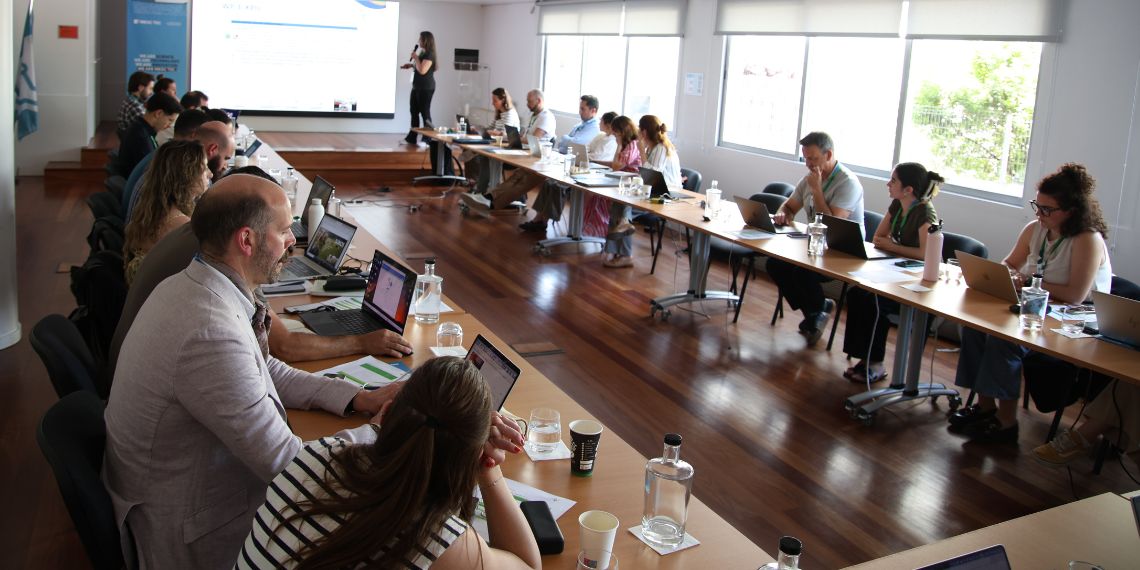
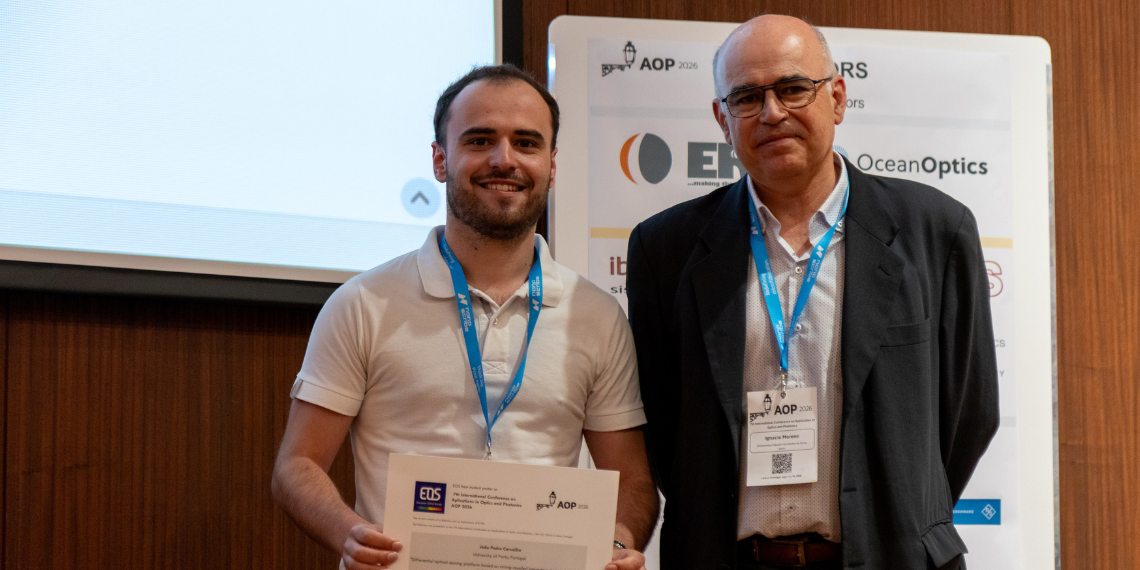
Os investigadores do INESC TEC arrecadaram três prémios científicos e um prémio de fotografia na Conferência Internacional sobre Aplicações da Ótica e da Fotónica (AOP2026). Mas, a participação na AOP2026 não se ficou por aqui. Orlando Frazão foi eleito vice-presidente da direção Sociedade Portuguesa de Ótica e Fotónica e Susana Silva assume agora a presidência do Conselho Fiscal desta organização. Orlando Frazão foi ainda nomeado presidente do Portuguese Territorial Committee for Optics.

20 julho 2026

Fotónica

INNOAQUA: já existe tecnologia INESC TEC ao serviço de uma aquacultura sustentável

Já experimentou um hambúrguer à base de algas? Ou nuggets produzidos a partir de proteína cultivada em sistemas circulares? O papel das algas na alimentação será cada vez mais relevante e tudo começa com o reaproveitamento da água utilizada na produção de peixe, como tem sido mostrado no projeto INNOAQUA.  

16 junho 2026

Fotónica

Da Terra ao espaço: INESC TEC desenvolve tecnologia para comunicações quânticas seguras

E se fosse possível comunicar à escala global com níveis de segurança praticamente impossíveis de comprometer? A resposta pode estar nas comunicações quânticas. O INESC TEC está a estudar, otimizar e validar soluções que permitam assegurar uma transmissão fiável, estável e segura a 1550 nanómetros (nm) em condições reais ou próximas das reais.

12 junho 2026

Fotónica

Investigadora do INESC TEC distinguida na SPIE Photonics Europe 2026

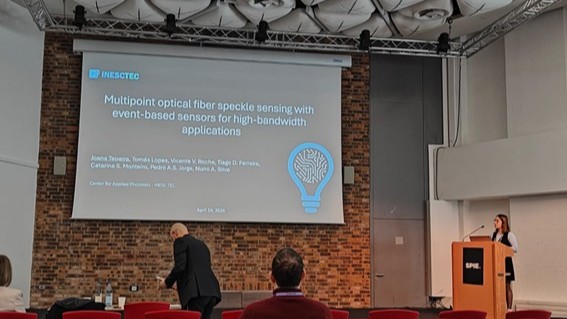
Joana Teixeira, investigadora do INESC TEC, recebeu o Best Student Paper Award na conferência SPIE Photonics Europe, pelo seu trabalho de investigação, que abre caminho ao desenvolvimento de soluções de sensorização ótica multiponto em tempo real, isto é, sistemas capazes de monitorizar vários pontos em simultâneo e em tempo real.

12 junho 2026

Tópicos
de interesse
025

Projetos em destaque

ELIANA

Electric Field-Assisted Immobilization of Anisotropic Nanoparticles to Excite Surface Plasmon Polaritons

2026-2027

QUANTHOS

QUANTHOS - Fotónica Integrada Topológica Quântica

2026-2027

HyperQuIm

Hyperspectral Quantum Imaging with Undetected Photons

2026-2027

ATLAS

Atlantic Tracking with Lightwave Acoustic Sensing

2025-2028

SMARTBOGIE

SMARTBOGIE – Solução Inovadora para a Mobilidade Ferroviária de Mercadorias

2025-2028

WaveSense

Advanced Nanotech-based Optical System Using Electromagnetic Surface Waves excitation for Ultra-Sensitive Detection of Water Contaminants

2025-2028

QuAC

Quantum fluids of light for All-optical Computing

2025-2027

eSPRcancer

Nova Ferramenta para o Diagnóstico do Cancro

2025-2028

ACLART

artificial intelligence-driven in silico simulation for prediction of anterior cruciate ligament reconstruction clinical outcomes

2025-2028

OGS

Portuguese Optical Ground Station

2025-2026

SPECTRA3D

Spectral Imaging and Augmented Reality for Disruptive Cultural Heritage Interpretation

2025-2027

OBSERVA

Observatório de Sinais Ópticos e Vigilância Acústica

2025-2026

POEMS

PORTUGUESE COMPETENCE CENTRE IN SEMICONDUCTORS

2025-2029

GEOSENSE

Polarization Harnessing in Submarine Optical Cables for Global Geophysical Sensing

2025-2026

LIBScan

Desenvolvimento de um espetrómetro transportável LIBS com mapeamento rápido

2024-2027

INNOAQUA

Innovative Approaches for an Integrated Use of Algae in Sustainable Aquaculture Practices and High-Value Food Applications

2023-2027

SUBMERSE

SUBMarine cablEs for ReSearch and Exploration

2023-2026

MODAS

Monitoring the Oceans with Distributed Acoustic Sensing

2023-2026

ATE

Aliança para a Transição Energética

2023-2026

AgendaTransform

Agenda para a transformação digital do setor florestal para uma economia resiliente e hipocarbónica

2022-2026

OmicBots

High-Throughput Integrative Omic-Robots Platform for a Next Generation Physiology-based Precision Viticulture

2022-2026

LIRA

Optical Fiber Micro-Kelvin Temperature Sensor Network For Sensitive Optical Payloads

2021-2025

HfPT

Health from Portugal

2021-2026

EUSCORES

EUropean - Scalable and Complementary Offshore Renewable Energy Sources

2021-2027

DFOSREN

DFOS – distributed fibre optic sensing para deteção de colisões nas linhas aéreas de muito alta tensão

2021-2025

Equipa
  • a
  • b
  • c
  • d
  • e
  • f
  • g
  • h
  • i
  • j
  • k
  • l
  • m
  • n
  • o
  • p
  • q
  • r
  • s
  • t
  • u
  • v
  • w
  • x
  • y
  • z
Publicações

2026

Sensors: The Building Blocks of a Technology-Driven Future

Autores
Farahi, F; Santos, JL;

Publicação
IEEE Sensors Reviews

Abstract

2026

Minimizing LIBS damage in the analysis of decorative tiles using RGB data clustering

Autores
Cavaco, R; Capela, D; Jorge, PAS; Silva, NA; Guimaraes, D;

Publicação
JOURNAL OF CULTURAL HERITAGE

Abstract
Spectral analysis of cultural heritage materials offers valuable insights into the restoration and preservation of historical artifacts, revealing details about the materials used and the manufacturing techniques employed. However, given their historical and artistic significance, the extraction of elemental information from these fragile samples poses a unique challenge, as these objects must be examined using minimally invasive methods to prevent irreversible damage. Laser-induced Breakdown Spectroscopy (LIBS) is one such technique, providing a rapid and detailed elemental characterization. Yet, extensive LIBS analysis can still compromise the integrity of these delicate objects. In this work, a novel approach that integrates spectral and RGB data clustering to significantly reduce the number of LIBS measurements required is introduced. By segmenting the material into visually and chemically distinct clusters, this method enables targeted LIBS analysis using only a few representative shots per cluster, thus preserving the integrity of cultural heritage artifacts while still delivering reliable compositional insights. (c) 2026 The Author(s). Published by Elsevier Masson SAS. This is an open access article under the CC BY license (http://creativecommons.org/licenses/by/4.0/)

2026

Real-Time Probing of Molecular Affinity Using Optical Tweezers

Autores
Teixeira, J; Ribeiro, JA; Monteiro, M; Silva, NA; Jorge, PAS;

Publicação
SENSORS

Abstract
The ability to assess molecular binding kinetics in real time is critical for advancing our understanding of molecular interactions in biochemical and biotechnological systems. This work presents a novel optical tweezer (OT)-based method to monitor molecular affinity in real time, focusing on the high-affinity streptavidin-biotin system as a model. Transparent poly(methyl methacrylate) (PMMA) microparticles functionalized with streptavidin were trapped before, during, and after binding with biotinylated bovine serum albumin (biotin-BSA), enabling the analysis of forward-scattered signals to detect nanoscale changes in particle size. By applying the Power Spectral Density method, the friction coefficient of individual particles was calculated, allowing for real-time tracking of binding dynamics and the estimation of the association rate constant (kon approximate to 106M-1s-1). These results are consistent with literature values and demonstrate the potential of this OT-based approach for non-invasive, label-free detection of molecular interactions. Compared to existing techniques, such as atomic force microscopy and cantilever-based sensors, this method offers significant advantages, including real-time monitoring, adaptability to different bioaffinity systems, and compatibility with miniaturized setups. This work establishes a foundation for using OT-based tools to monitor high-affinity molecular interactions in real time. While demonstrated here using biotinylated BSA as a model ligand, future studies will explore the method's applicability to smaller ligands and more subtle surface modifications.

2026

Accurate Determination of the Temperature Sensitivity of UV-Induced Fiber Bragg Gratings

Autores
Cosme, M; Pota, M; Preizal, J; Caldas, P; Oliveira, R; Nogueira, R; Araújo, FM; Cruz, JL; Rego, GM;

Publicação
SENSORS

Abstract
Over the past 18 months, we have performed hundreds of temperature characterizations of fiber Bragg gratings inscribed in different germanium-doped silica glass fibers. Under experimental conditions, the main conclusions are as follows: the temperature dependence of the temperature gauge factor or the normalized temperature sensitivity, K-T, was found to be quadratic in the -50-200 degrees C range, while it may be considered linear for the -20-100 degrees C range; K-T values at 20 degrees C vary from 5.176 x 10(-6) K-1, for a B/Ge co-doped fiber up to 6.724 x 10(-6) K-1, for a highly Ge-doped fiber; K-T does not depend on the hydrogen-loading process or the gratings coupling strength; K-T is essentially independent of wavelength in the 1500-1600 nm range, its value being accurately determined with a relative error similar to 0.2%; based on the accurate value of K-T = 6.165 x 10(-6) K-1, at 20 degrees C, obtained for gratings inscribed in the SMF-28 fiber, we calculated a value of 19.4 x 10(-6) K-1 for the thermo-optic coefficient of bulk germanium glass; and gratings produced by femtosecond-laser radiation and UV-laser radiation exhibit comparable values of K-T. The previous achievements allow, by having knowledge of K-T for a single grating, the accurate determination of the temperature dependence of the Bragg wavelength for any other grating inscribed in the same fiber; the presented methodology enables one to determine the unknown gratings' temperature sensitivity, typically with an error of 0.01 pm/degrees C, being, therefore, very useful in research labs and computer simulations. Thus, expressions for the temperature dependence of K-T for gratings inscribed in several fibers are given, as well as an expression for K-T as a function of the effective refractive index. We have also fully analyzed the potential sources of error in K-T determination.

2026

Fano Resonance of Fiber Bragg Grating for Liquid Sensing

Autores
Piaia, V; Alves, MR; Robalinho, P; Silva, S; Frazao, O;

Publicação
JOURNAL OF LIGHTWAVE TECHNOLOGY

Abstract
The decoupling of temperature and refractive index measurements was achieved by exploiting the properties of the asymmetric spectrum generated by Fano resonance, resulting from the interference between the Bragg reflection of the grating and the Fresnel reflection at the fiber tip. This spectral asymmetry enabled the implementation of a combined wavelength-based and intensity-based interrogation scheme. By separating the influence of each parameter in the spectral response, it was possible to measure the refractive index independently, without interference from temperature variations. A refractive index sensor with a minimum detectable change of delta = 1.2 & times; 10(-4) RIU was demonstrated. In addition to introducing a novel structure that leverages Fano resonance, the sensor was also applied as an evaporation rate sensor. The results demonstrate its potential for a wide range of applications, serving as a foundation for the development of future optical sensing technologies.