Cookies Policy
The website need some cookies and similar means to function. If you permit us, we will use those means to collect data on your visits for aggregated statistics to improve our service. Find out More
Accept Reject
  • Menu
Facts & Numbers
000
About

About

INESC TEC is a private non-profit research association, with Public Interest status, dedicated to scientific research and technological development, technology transfer, advanced consulting and training, and pre-incubation of new technology-based companies.

As an institution operating at the interface of the academic and business worlds, bringing closer together academia, companies, public administration, and society, INESC TEC typically applies the knowledge and results generated as part of its research in technology transfer projects, seeking value creation and immediate social relevance.

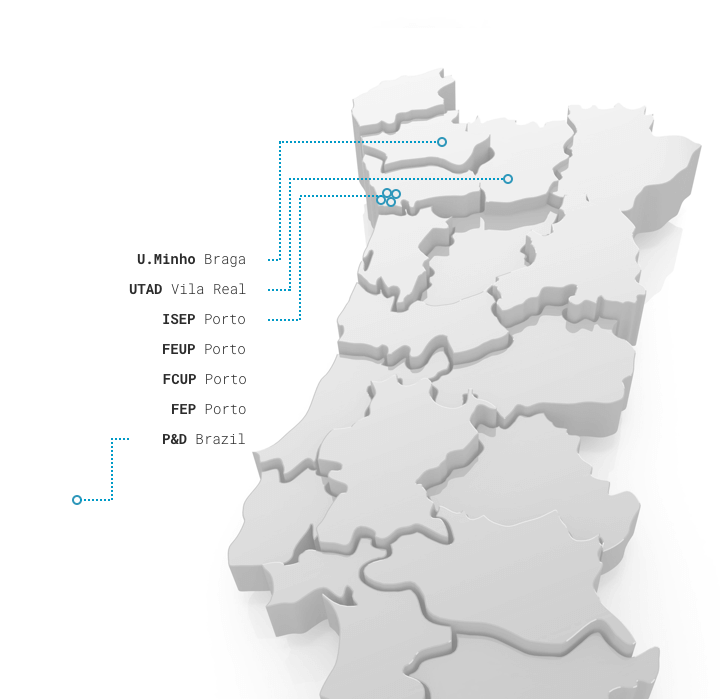
“Present in 6 sites in the cities of Porto, Braga and Vila Real, INESC TEC incorporates 13 R&D Centres”

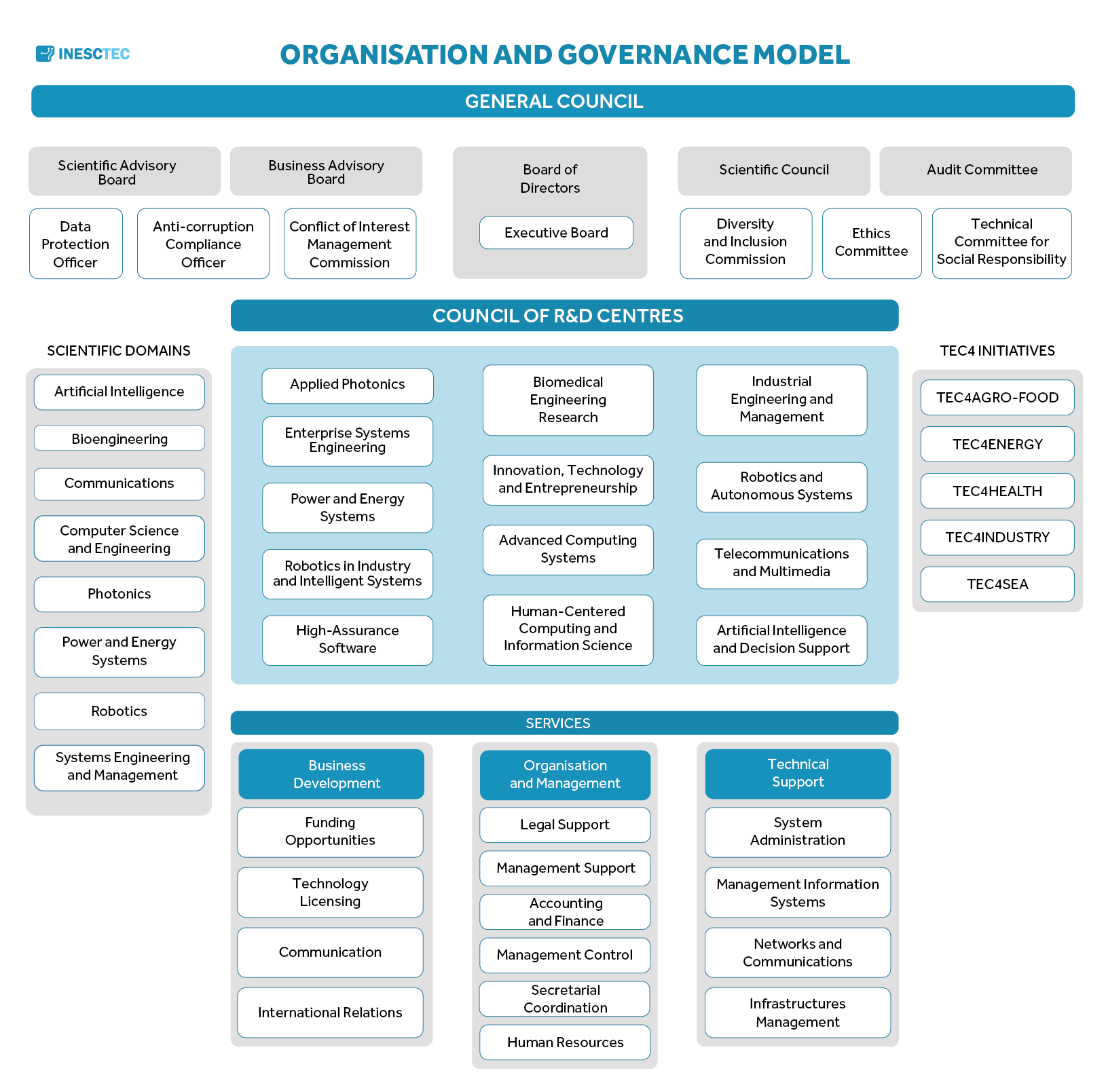
The 13 R&D Centres of INESC TEC are structured in four thematic domains - Computer Science, Industrial and Systems Engineering, Networked Intelligent Systems, and Power and Energy.

INESC TEC hosts over 700 integrated researchers (about 350 PhDs), including staff researchers, researchers from Higher Education Institutions, grant holders and affiliated researchers. INESC TEC’s team also includes trainees, and technical and administrative support staff.

Purpose

To create a fulfilling and sustainable future through impactful science, technology, and innovation.

Vision

To be an inspiring and empowering force, driving the science and technology of digitally-enabled systems into overcoming society’s challenges.

Mission

As a free-thinking and diverse community, we take on bold science, technology, and innovation challenges, empowering talent, collaborative ecosystems, and public policies that make a difference in our economy and society.

Values

Rigour and Excellence

Integrity, Transparency, and Ethics

Creativity, Boldness, Curiosity, and Innovation

Freedom to Create and Think

Collaboration

People-Centredness and Inclusion

“International and Socially Relevant Science, with an Impact on Industry, Services and Exports.”

INESC TEC’s strategy is driven by a conceptual vision that encompasses the following axes:

  • Excellence in science, talent development, technology transfer and collaboration with industry
  • Full coverage of the knowledge-to-value chain
  • Multidisciplinarity
  • Scale, density, critical mass and integration
  • International visibility and presence

FCT-CIT-LOGOS

INESC TEC’s management and operational model implements the concept of the knowledge-to-value production chain, leading the research activity from knowledge generation to its valorisation through a mix of technology transfer processes, from the pure transfer of technology to collaborative development, advanced consulting and training, until the possible creation of spin-offs.

Structure

Institutional Structure

INESC TEC has a unique and differentiating management model, improved over its 35 years of history.

Reflecting its unique position between academia and industry, the management at INESC TEC carefully balances, in a hybrid model, the academic culture of scientific freedom and dialogue with a culture of efficiency and responsibility in management.

Therefore, great freedom is given to R&D Centres in order to define their own guidance and to conduct their activity, while giving a considerable individual freedom to each collaborator. This freedom is always matched with an interest in preserving the continuity of knowledge generation, ensuring a joint and coherent vision of the institution’s evolution, not reducing it to a mere aggregation of fragmented policies.

On the other hand, a culture of responsibility at all management levels is widely fostered, supported by professional services that inform, support and give account for the organisation and its activity.

Organograma
Associates

Associates

We conduct socially relevant research with our associates.

University of Porto

Associates

University of Porto

Polytechnic Institute of Porto

Associates

Polytechnic Institute of Porto

INESC

Associates

INESC

University of Minho

Associates

University of Minho

University of Trás-os-Montes and Alto Douro

Associates

University of Trás-os-Montes and Alto Douro

Partnerships with International Universities

We have partnerships of excellence with multidisciplinary teams.

CMU Portugal

Partnerships with International Universities

CMU Portugal

MIT Portugal

Partnerships with International Universities

MIT Portugal

UT Austin Portugal

Partnerships with International Universities

UT Austin Portugal

Participation in other entities

Participation in other entities

In order to promote knowledge and competence sharing, INESC TEC is currently a full member of more than fifty Associations, at national and international levels. In addition to the regular engagement in their activities, INESC TEC also actively participates in several Boards, Committees, and Working Groups, thus enhancing the gathering and sharing of knowledge with other leading experts in its fields of activity.

Furthermore, INESC TEC supports the launch of technology-based spin-offs expressly established to develop further and exploit intellectual property created by INESC TEC. Over the years, it has ensured the pre-incubation of new business projects or startups in a test concept, currently remaining with shareholding only in the most recent or under development spin-offs.

Get to know the entities:

6G-IA - 6G SMART NETWORKS AND SERVICES INDUSTRY ASSOCIATION

ACPMR - Associação Cluster Portugal Mineral Resources (CLUSTER)

ADEPORTO - Agência de Energia do Porto

ADRA - AI, DATA AND ROBOTICS ASSOCIATION

ADVID - ASSOCIAÇÃO PARA O DESENVOLVIMENTO DA VITICULTURA DURIENSE (CLUSTER) (COLAB)

AEDCP – Associação Portuguesa para o Cluster das Indústria Aeronáutica, do Espaço e da Defesa (CLUSTER)

AEF - the Agricultural Industry Electronics Foundation

AEP - Associação Empresarial de Portugal

AIOTI - ALLIANCE FOR INTERNET OF THINGS INNOVATION

APDIO - Associação Portuguesa para o Desenvolvimento da Investigação Operacional

APGEI – ASSOCIAÇÃO PORTUGUESA DE GESTÃO E ENGENHARIA INDUSTRIAL

APICCAPS - Associação Portuguesa dos Industriais de Calçado, Componentes, Artigos de Pele e seus Sucedâneos (CLUSTER)

APVE - ASSOCIAÇÃO PORTUGUESA DO VEÍCULO ELÉCTRICO

AQUAVALOR - CENTRO DE VALORIZAÇÃO E TRANSFERÊNCIA DE TECNOLOGIA DA ÁGUA – ASSOCIAÇÃO (COLAB)

ASTP_Proton

ATE - ASSOCIAÇÃO ALIANÇA PARA A TRANSIÇÃO ENERGÉTICA

B2E ASSOCIAÇÃO PARA A BIOECONOMIA AZUL - LABORATÓRIO COLABORATIVO (COLAB)

BATPOWER - ASSOCIAÇÃO PORTUGUESA PARA O CLUSTER DAS BATERIAS (CLUSTER)

BDVA - BIG DATA VALUE ASSOCIATION

BUILT (ASSOCIAÇÃO BUILT COLAB – COLABORATIVE LABORATORY FOR THE FUTURE BUILT ENVIRONMENT)

Câmara de Comércio e Indústria Luso-Francesa (CCILF)

CENTRA - Collaborations to Enable Transnational Cyberinfrastructure Applications

CERVIM - CENTRE OF RESEARCH, STUDIES, SAFEGUARDING, COORDINATION AND PROMOTION OF MOUNTAIN VITICULTURE

Ciência Viva - Agência Nacional para a Cultura Científica e Tecnológica

CIGRÉ - International Council on Large Electric Systems

CITEVE - Centro Tecnológico das Indústrias Têxtil e do Vestuário de Portugal (CLUSTER)

CRESYM – COLLABORATIVE RESEARCH FOR ENERGY SYSTEM MODELING

DERlab - European Distributed Energy Resources Laboratories E. V.

EARTO - European Association of Research and Technology Organisations

EASTRO – European Association of Space Technology Research Organisations

EBRAINS AISBL

EERA - EUROPEAN ENERGY RESEARCH ALLIANCE

EES-UETP - Electric Energy Systems - University Enterprise Training Partnership

EFFRA - EUROPEAN FACTORIES OF THE FUTURE RESEARCH ASSOCIATION

EIT MANUFACTURING (KIC)

EIT RAW MATERIALS e. V. (KIC)

EPIC – EUROPEAN PHOTONICS INDUSTRY CONSORTIUM

ERCIM - European Research Consortium for Informatics and Mathematics

ERMA (European Raw Materials Alliance)

EtherCAT Technology Group

ETSI - EUROPEAN TELECOMMUNICATIONS STANDARDS INSTITUTE

EuRobotics aisbl

FEEDINOV - ASSOCIAÇÃO PARA A INVESTIGAÇÃO E INOVAÇÃO EM NUTRIÇÃO E ALIMENTAÇÃO ANIMAL (COLAB)

ForestWISE – Associação para o Laboratório Colaborativo para a Gestão Integrada da Floresta e do Fogo (COLab)

FÓRUM OCEANO - Associação da Economia do Mar (CLUSTER)

FUNDAÇÃO AEP

Gaia-X - A Federated Secure Data Infrastructure

HEALTH CLUSTER PORTUGAL – Associação do Pólo de Competitividade da Saúde (CLUSTER)

HyLAB – Green Hydrogen Collaborative Laboratory

IDSA - International Data Spaces Association

IEA WIND - International Energy Agency - Task proposal Forecasting for Wind Energy

IEP - Instituto Electrotécnico Português

INESC P&D Brasil

ITS Portugal - Associação Portuguesa para a promoção de Sistemas e Serviços Inteligentes de Transporte

MOBINOV - Associação do Cluster Automóvel (CLUSTER)

PFP - Associação da Plataforma Ferroviária Portuguesa (CLUSTER)

PRODUTECH - Associação para as Tecnologias de Produção Sustentável (CLUSTER)

RAIL COLAB - COLLABORATIVE LABORATORY FOR THE FUTURE RAILWAY SYSTEM (COLAB)

RISC-V INTERNATIONAL ASSOCIATION

ROS-INDUSTRIAL CONSORTIUM EUROPE

Smart Energy Lab – Association (COLAB)

Smart Waste Portugal

SPR - Sociedade Portuguesa de Robótica

STICHTING SPRINT ROBOTICS COLLABORATIVE (THE SPRINT ROBOTICS COLLABORATIVE FOUNDATION)

TICE.PT - Associação para o Pólo das Tecnologias de Informação, Comunicação e Electrónica (CLUSTER)

VASCO DA GAMA COLAB - ENERGY STORAGE - ASSOCIAÇÃO (COLAB)

VORTEX - Associação para o Laboratório Colaborativo em Sistemas Ciber-Físicos e Ciber-Segurança (COLAB)

World Alliance for Efficient Solutions (WA4ES)

Institutional Documents
Contributions to the AI²

INESC TEC’s Contributions to the AI² Strategic Assessment Process

INESC TEC has been actively involved in the AI² Strategic Assessment Process. We believe it provides an opportunity to bring greater coherence to investment in research and innovation in Portugal. This reform will reinforce Portugal’s ability to produce world-class knowledge, transform the economy by improving the specialisation profile, and address societal challenges. This requires two key priorities: an open and comprehensive scientific base, and targeted investment in areas where Portugal seeks to transform the country’s economy and stand out in Europe and worldwide.


Considering this, the contributions compiled on this page are presented in chronological order according to the different stages of the AI² Strategic Assessment Process.

Methodological design of the process - public consultations promoted by AI²

- January 2026 - Contribution to the strategic assessment methodology for defining strategic domains and budget allocation

- July 2026 - Comments on the Strategic Focus Report

Bottom-up initiatives - strategic reflection on long-term themes, priorities and ambitions

- September 2026 - Report from a panel involving internal and external participants

- September and October 2026 - Six thematic documents

- September 2026 - Budget allocation proposal

Summary

- October 2026 - Brief compilation of the main proposals from the eight contributions produced under the bottom-up initiatives


↓ Summary [PDF] (portuguese only)

↓ Download all documents [ZIP]

In the first phase of the process, we contributed to the definition of the Strategic Thinking for Sustainability (ST4S) methodology, which provided the basis for identifying strategic priorities.

Our main recommendations were to:

- Distinguish between strategic options developed during the process and those subject to political decision-making.

- Address strategic domains as an outcome, rather than a starting hypothesis.

- Include a formal strategic synthesis stage before decisions are made.

Document:

↓ AI² Strategic Assessment Methodology [PDF, 4 pp., Jan. 2026, PT only]


During the methodology design stage - and as part of AI²’s Strategic Focus Report - we reviewed the proposed assessment framework and critical decision factors for defining the strategic domains. Our main recommendations were to:

- Introduce a formal stage for developing and refining options. The ability of critical factors to distinguish between alternatives depends on those alternatives reaching the assessment stage at a similar level of maturity. We recommended a preliminary phase to develop and refine the options, ensuring that the comparison focuses on their respective merits rather than on how far each has progressed.

- Classify indicators according to their decision-making weight. Some describe the starting point, others help distinguish between options, while others monitor implementation. We proposed making these roles explicit, alongside the limitations of each indicator, particularly when applied to emerging fields or to pathways spanning the entire value chain.

- Treat the final decision as a means of building a dynamic portfolio. Rather than simply producing a list of selected domains, the goal should be to establish a portfolio that remains viable over time. We recommended distinguishing between strategic domains, cross-cutting capabilities and the scientific base to be preserved, while allowing sufficient flexibility to adjust course without compromising the portfolio.


Document:

↓ Comments on the Strategic Focus Report [PDF, 19 pp., Jul. 2026, PT only]

A strategic domain should identify a transformation that matters to the country, the position Portugal aims to achieve, and the capabilities needed to make it happen. A sectoral or technological label alone is not enough to define such a choice.


INESC TEC therefore proposes that the definition and selection of strategic domains should jointly address three questions:

- What problem or opportunity justifies coordinated intervention?

- What capabilities and international standing does Portugal have, or could it develop?

- What pathway, involving which stakeholders, resources and commitments, would make this ambition credible?


The evidence used should be appropriate to the maturity of each strategic investment, without automatically favouring what already exists or if novelty guarantees potential. The assessment should help distinguish where Portugal should seek leadership, where it should develop the country’s own capabilities, and where it should ensure access through European and international cooperation. However, the necessary selectivity must go hand in hand with preserving investigator-led research and supporting innovation opportunities that emerge outside the selected domains.

The panel report on AI²’s strategic domains and regional, national and European alignment brought together internal and external participants, under a non-attribution rule whereby individual contributions are not attributed to specific participants. It sets out questions and conditions for assessing strategic options, without selecting specific domains or allocating resources.

Complete report:

↓From knowledge to strategic capabilities [PDF, 13 pp., Set. 2026, PT only]

We have developed six thematic proposals identifying areas in which Portugal could build scientific and technological capabilities by 2036. Our proposals cover both cross-cutting technologies and application areas – dedicated to (depending on the case) strengthen existing capabilities or establish new areas of specialisation.

Our goal is not to provide an exhaustive list of national strategic priorities, but to contribute to their definition based on the expertise and partnerships we have mobilised. These proposals should be assessed collectively, recognising complementarities, making the most of shared capabilities and avoiding duplicated funding, while preserving the specific challenges of each area.


Critical technologies for digital sovereignty

Strengthen Portugal’s ability to make technological choices and play an active role in essential digital systems by mobilising expertise in chips, communications, Artificial Intelligence (AI), robotics, and quantum technologies. The goal is to develop knowledge, intellectual property and home-grown solutions in selected segments, while complementing these efforts with access to resources that require greater scale through European cooperation. The proposed areas of specialisation include circuit design and integrated photonics, resilient networks, efficient and trustworthy AI, robotic autonomy, and quantum software engineering. This requires funding that combines long-term research, shared infrastructures and demonstrations conducted in collaboration with end users.

↓ Download [PDF, 15 pp., PT only]


Sustainable energy systems

Harmonise the electrification of the economy and the development of clean technologies with the need to ensure a secure, resilient and flexible power grid. Building on Portugal’s experience in integrating renewable energy, the goal is to attract industrial investment and develop solutions with export potential. Key opportunities include operating grids with a high share of power-electronic converters, demand-side flexibility, climate resilience and the application of AI to energy systems. This calls for a power grid innovation programme, with regulated access to data and testing under real-world conditions, bringing together scientific institutions, companies, grid operators, and the regulator.

↓ Download [PDF, 16 pp., PT only]


Digitalisation of the manufacturing sector

Increase productivity and added value across companies and their respective value chains, while strengthening Portugal’s domestic manufacturing technology offering. The focus is on specific industrial challenges: integration with existing equipment, adaptation to short production runs and raw materials of varying quality, data governance, and collaboration between people and intelligent systems. This requires consolidating the cooperation established through the Mobilising Agendas and expanding demonstrations in industrial environments, while ensuring access for new participants.

↓ Download [PDF, 23 pp., PT only]


The ocean as a national strategic priority

Move beyond an approach based primarily on campaigns towards a sustained technological presence at sea, capable of supporting continuous observation, operations, production, and protection. This brings together expertise in resident autonomous systems, underwater communications, and navigation, structural and materials integrity, ocean energy and data, creating business opportunities in solution qualification, monitoring, and the operation and maintenance of maritime infrastructures. This requires ensuring the continuous operation of testing infrastructures, training specialised engineers and technical staff, and promoting demand from both the public and private sectors.

↓ Download [PDF, 17 pp., PT only]


Healthcare technologies and engineering

This proposal identifies three subdomains within a broader national healthcare priority: translational neuroengineering, AI-supported precision oncology, and trustworthy health data, including computational modelling for biomedical and pharmaceutical research. The goal is to turn successful individual projects into a sustained capacity to develop and validate technologies, create businesses and improve healthcare. This requires appropriate infrastructures, multicentre validation in hospitals and primary care settings, protected time for healthcare professionals to conduct research, and secure access to data.

↓ Download [PDF, 18 pp., PT only]


People-centred urban mobility

Develop more accessible, adaptive, sustainable, and resilient mobility systems by integrating data, transport modes, services, and territorial planning. The opportunity to stand out lies in combining knowledge of mobility and human behaviour with the technological expertise needed to integrate systems and services. This requires municipalities, authorities, and operators to be involved from the initial identification of problems through to the adoption of solutions, as well as testing in Portuguese cities and transport networks to develop interoperable and replicable solutions.

↓ Download [PDF, 16 pp., PT only]


Creating the conditions to turn strategic choices into reality

Despite showing different ambitions, the six proposals share a common requirement: turning investment in research and innovation into capabilities that endure beyond individual projects. This means combining support for scientific discovery and engineering with the training and retention of talent, while creating the conditions to put results to use and (wherever there is potential for application) extending demonstrations into a pathway towards validation, adoption and, where appropriate, industrialisation.

This also requires clear governance for each domain, with defined responsibilities and concrete commitments from partners. Where adoption depends on regulation, access to data or public procurement, AI²’s programme must be supported by commitments from the relevant government departments, regulators, and user organisations, ensuring compliance with national policies and strategies. It is crucial to fund infrastructures throughout the whole lifecycle and include experimental regulatory environments that enable regulated access to data and the testing of solutions under real-world conditions.

Finally, programme monitoring must distinguish between scientific quality, the capabilities created, the use of results and the impacts achieved. Independent evaluation should inform decisions on whether to scale up, redesign or discontinue initiatives.

Delivering these priorities and creating the conditions for their implementation requires stable, multiannual financial planning. We propose translating the national target of 3% of GDP in public and private R&D investment by 2030 into a roadmap setting out resources and responsibilities. AI²’s programme contract should specify the Agency’s contribution, coordinate national and European funding sources, and ensure that the capabilities developed continue beyond temporary support schemes.

As an initial reference for the resources managed by AI², we propose:

- 40% for Science, 30% for Strategic Domains, 15% for the Innovation Promotion Unit (UPI), and 15% for Research and Technological Infrastructures. This is a starting point for planning, potentially adaptable considering the budget scope, existing commitments, and identified needs.

- Core institutional funding as a cross-cutting component. One-third of the Science allocation and one-third of the combined allocations for Strategic Domains and the UPI, ensuring continuity for teams, advanced training, and the development of new capabilities.

- New funding does not have to follow the same proportions. It may be allocated in response to identified needs and obstacles, while honouring existing commitments and preserving room for budgetary adjustments.


The document sets out the reference framework, allocation criteria, three non-compensatory tests for the design and selection of strategic domains, and the proposed scale of core institutional funding. It also includes two annexes providing supporting evidence and international comparisons.

↓ AI² Budget Allocation [PDF, 10 pp, Sep. 2026, PT only]

We have compiled the main proposals from the eight contributions developed through AI²’s bottom-up initiatives in a single summary note – organised into four sections:

- Choosing with ambition and evidence: we believe that a strategic domain should identify a transformation that matters to the country, the position Portugal aims to achieve, and the capabilities needed to make it happen. A sectoral or technological label alone is not enough to define such a choice.

- Six contributions to national priorities: we present six thematic proposals identifying opportunities for transformation and for building scientific and technological capabilities that are relevant to Portugal, with 2036 as the target horizon.

- Creating the conditions to turn strategic choices into reality: our six proposals share a common requirement: turning investment into capabilities that endure beyond individual projects. This calls for clear governance for each domain, with concrete commitments from partners and compliance with national policies and strategies; infrastructures funded throughout the whole lifecycle, including experimental regulatory environments and regulated access to data; and monitoring that distinguishes scientific quality, the capabilities created, the use of results and the impacts achieved, supported by independent evaluation.

- Funding with continuity and adaptation ability in mind: we propose translating the target of investing 3% of GDP in R&D by 2030 into a roadmap setting out resources and responsibilities. AI²’s programme contract should specify the Agency’s contribution, using the following indicative allocation: 40% for Science, 30% for Strategic Domains, 15% for the Innovation Promotion Unit (UPI) and 15% for Infrastructures, with core institutional funding as a cross-cutting component.


Scientific ambition, strategic thinking and decision-making, and a commitment to implementation must therefore go hand in hand.

Document:

↓From knowledge to strategic capabilities - summary [PDF, Oct. 2026, PT only]


INESC TEC reaffirms the commitment to work with AI² and the relevant government departments to further develop these proposals, help define national priorities and support their implementation.

REPORTING CHANNEL

INESC TEC provides an electronic platform for reporting infringements or irregular conduct in three areas: Ethics, Harassment, and Corruption and Breaches of EU Law. The Reporting Channel is implemented on a secure platform. For anonymous reports you may want to use a new incognito window in the Tor browser.

MORE INFO

Where we Are

INESC TEC is composed of 13 R&D centres in five different locations (ISEP, FEUP, FCUP, UMinho and UTAD) and 2 special partnerships (IPB and U Aberta). Presently, its main sites are in the cities of Porto, Braga and Vila Real.

In 2012, INESC TEC’s organisational and science management model was exported to Brazil, and so INESC P&D Brasil (INESC R&D Brazil) was created. Its network already features over 13 universities, from 11 Brazilian states, whose goal is to produce science, transfer technology and create value in Brazil.

Get contacts